
India's First Nuclear-Powered Hydrogen Plant and Net-Zero Strategy
India has successfully commissioned a pilot facility at Kalpakkam to produce hydrogen using nuclear process heat, marking a shift from traditional electricity-based electrolysis. This initiative utilizes the Copper-Chlorine thermochemical process developed by the Bhabha Atomic Research Centre to support the nation's goal of energy independence by 2047. While the technology offers a consistent, carbon-free alternative to intermittent renewable energy, it remains in a demonstration phase with significant engineering hurdles to overcome. Commercial viability depends on future scaling strategies, specialized corrosion-resistant materials, and the successful integration of advanced gas-cooled reactors. Global research also emphasizes the critical need for stringent safety protocols when co-locating nuclear and hydrogen production plants. Progress toward Net Zero by 2070 will require these experimental efforts to eventually become cost-competitive with established fuel production methods.
SCIENCE HISTORYBUSINESS HISTORY
6/29/20264 min read
The Heat is On: Why India’s New Nuclear-Powered Hydrogen Plant is a 24/7 Game Changer
The global race for Green Hydrogen is currently dominated by a singular narrative: the proliferation of wind turbines and solar arrays. While the falling costs of renewables are impressive, industrial strategists are increasingly focused on the "intermittency bottleneck." For heavy industries like steel and fertilizer, which require a constant, high-volume flow of fuel, relying on weather-dependent energy creates a reliance on the prohibitive capital expenditure of seasonal storage and massive battery buffers.A strategic milestone at the Indira Gandhi Centre for Atomic Research (IGCAR) in Kalpakkam suggests a more resilient alternative. By commissioning a pilot facility that harnesses nuclear energy, India is pioneering a way to decouple hydrogen production from atmospheric whims. This isn't just another energy project; it is a fundamental shift toward "baseload hydrogen"—an always-on clean fuel supply that could de-risk the transition to a low-carbon economy.
Takeaway 1: It’s Not About Electricity, It’s About the Heat
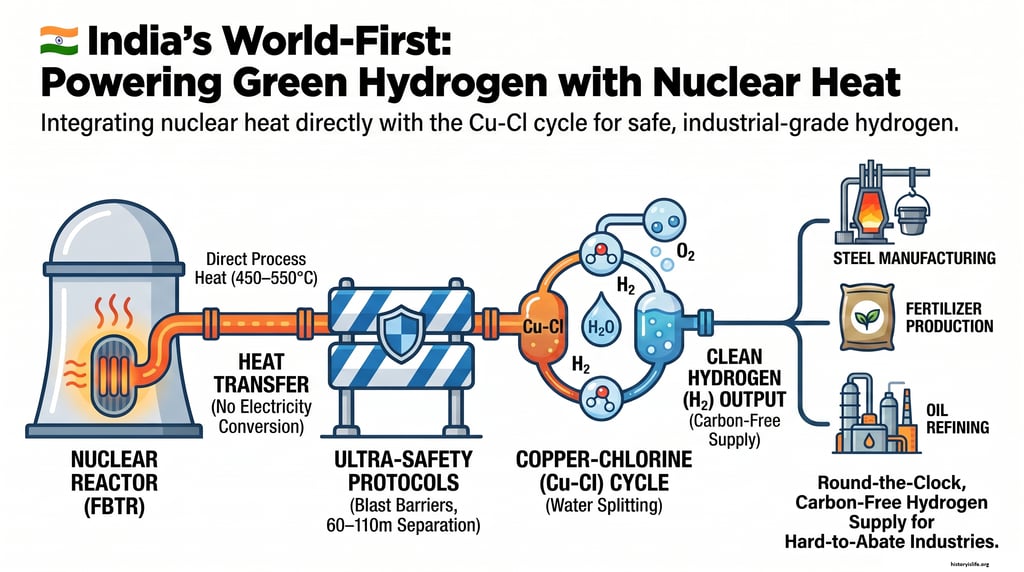
Most contemporary "green" hydrogen initiatives rely on conventional electrolysis, a process that is often inefficient due to cumulative losses. When electricity travels from a solar farm, through the grid, into an inverter, and finally to an electrolyzer, a significant portion of the initial energy is dissipated. The Kalpakkam facility represents a fundamental shift toward the Copper-Chlorine (Cu-Cl) thermochemical process .Developed indigenously by the Bhabha Atomic Research Centre (BARC), this technology does not merely use a nuclear reactor as a power source for a standard electrolyzer. Instead, it utilizes direct "process heat" to drive the heavy lifting of water splitting. Crucially, the Cu-Cl cycle is a hybrid thermochemical process. While it uses heat for the high-temperature thermolysis step, it requires only a "minor" electrical input for a low-temperature electrolysis stage (60–80°C)."BARC Cu-Cl technology has been developed and demonstrated... as a water splitting through a series of closed loop chemical reactions... Net Input are Water, Heat (major) & Electricity (minor)."By leveraging this thermal-to-fuel pathway, the process achieves a projected efficiency of approximately 45%. This direct application of thermal energy bypasses many of the conversion losses inherent in the renewable-to-electricity-to-hydrogen route, making the production cycle significantly more streamlined.
Takeaway 2: Breaking the Chains of Intermittency
The primary strategic advantage of nuclear-powered hydrogen is its consistency. Unlike solar or wind, which have low capacity factors, nuclear reactors provide a steady, high-temperature output around the clock. This reliability is vital for the decarbonization of heavy industries that cannot afford the operational disruptions caused by energy variability.This move supports India's National Green Hydrogen Mission and aligns with the broader mandate of energy independence by 2047. By diversifying the technology stack beyond weather-dependent renewables, India is building a more sophisticated energy architecture—one where nuclear power serves as the foundational "battery" for industrial hydrogen needs.
Takeaway 3: The Economic "Holy Grail" – ₹100 to ₹200 per Kilogram?
In the world of energy strategy, the Levelized Cost of Hydrogen (LCOH) is the ultimate metric of success. BARC materials indicate that the Cu-Cl process is "techno-commercially attractive," with a projected LCOH of ₹100 to ₹200 per kilogram .If achieved, this price point would be a major breakthrough, placing clean hydrogen on a level playing field with fossil-fuel-based alternatives. However, a necessary "Business Reality Check" is in order: this ₹100 to ₹200/kg target is contingent on large-scale centralized production , not the current pilot scale. While the 45% efficiency is a high-water mark for laboratory and pilot targets, the technology must now survive the transition from a controlled research environment to a rugged industrial reality.
Takeaway 4: The Engineering High-Wire Act (Safety and Materials)
Operating a chemical plant in tandem with a nuclear reactor is an engineering high-wire act that requires uncompromising safety protocols. To manage the risks of co-location, the project adheres to a tiered safety framework popularized by global standards (such as those from the Idaho National Laboratory):
Primary: Preventing reactor core damage.
Secondary: Managing equipment failure or chemical leaks.
Tertiary: Minimizing impacts on normal operations and economic output.The technical requirements are punishing. The Cu-Cl process operates at high temperatures ( 500–530°C ), necessitating the use of specialized, corrosion-resistant materials to withstand the aggressive chemical environment of the thermolysis step. Regulatory logic follows the global gold standard set by the NRC: the connection of a hydrogen facility must pose "no statistically significant increased hazard to the nuclear plant."
Takeaway 5: From Lab to Life – The 2027 Roadmap
The transition from a scientific breakthrough to industrial infrastructure is measured by Technology Readiness Levels (TRL). Moving from a 150 NL/h pilot to full nuclear coupling is an aggressive engineering leap. The roadmap for India’s nuclear-hydrogen journey is as follows:
2023: Bench-scale closed loop (5 NL/h) demonstrated (TRL-5).
2024: Pilot-scale (150 NL/h) demonstrated for 225 hours (TRL-6).
2025: Prototype development at 3 Nm³/h (TRL-7/8).
2027: Planned demonstration of full nuclear-coupled hydrogen production ( Coupling with Na Loop of FBR ) (TRL-9/10).While the progression is steady, investors should view this as a strategic R&D effort. Currently, the facility is a technology demonstrator; it is a proof-of-concept for the future of the energy market, rather than an immediate driver of private sector revenue.
Conclusion: A 2070 Vision
The pilot facility at Kalpakkam is a critical piece of a much larger puzzle. As India aims for Net Zero by 2070 , it is planning a massive scaling of nuclear capacity—targeting 21,980 MWe by 2031-32.By integrating hydrogen production directly into the nuclear ecosystem, India isn’t just generating power; it’s creating a sustainable, industrial-scale fuel source. It raises a compelling question for the global energy market: as the limits of intermittent renewables and the costs of seasonal storage become clearer, is the world finally ready to re-embrace nuclear energy as the essential "battery" for the hydrogen economy?


