Why 35°C in London is Deadlier Than 45°C in Delhi: The Paradox of the European Heatwave
These reports examine why recent European heatwaves feel more lethal and intense than higher temperatures in tropical regions like India. Experts attribute this discrepancy to humidity, which hinders the body’s ability to cool itself, and infrastructure designed to trap heat for cold winters rather than dissipate it. Geographical factors, such as prolonged summer daylight and clearer skies, increase solar exposure, while a lack of widespread air conditioning creates a public health crisis. This situation has turned cooling into a political flashpoint, as governments struggle to balance emergency health needs with long-term climate commitments. Ultimately, the sources highlight that Europe is warming significantly faster than the global average, leaving its citizens and buildings ill-equipped for a new environmental reality.
SPACE HISTORYSCIENCE HISTORY
6/30/20265 min read
Why 35°C in London is Deadlier Than 45°C in Delhi: The Paradox of the European Heatwave
On June 28, 2026, the iconic zinc-clad attics of Paris ceased to be romantic symbols of the Belle Époque; they became airless kilns. As the mercury touched 40°C across Western Europe, the continent’s architectural heritage began hemorrhaging its cooling capacity. In France alone, that single week claimed 1,000 lives. To a resident of Delhi or Mumbai, where summer highs routinely scour the 45°C mark, the staggering mortality rate in Europe feels like a statistical error. How can a temperature that many in India would consider a "pleasant spring day" trigger a lethal public health emergency in London?
The answer is a brutal intersection of physics, urban geometry, and human physiology. While the thermometer provides a single, objective number, the "felt" heat is a narrative written by humidity, architecture, and the very air we breathe.
The Humidity Trap: When Sweat Stops Working
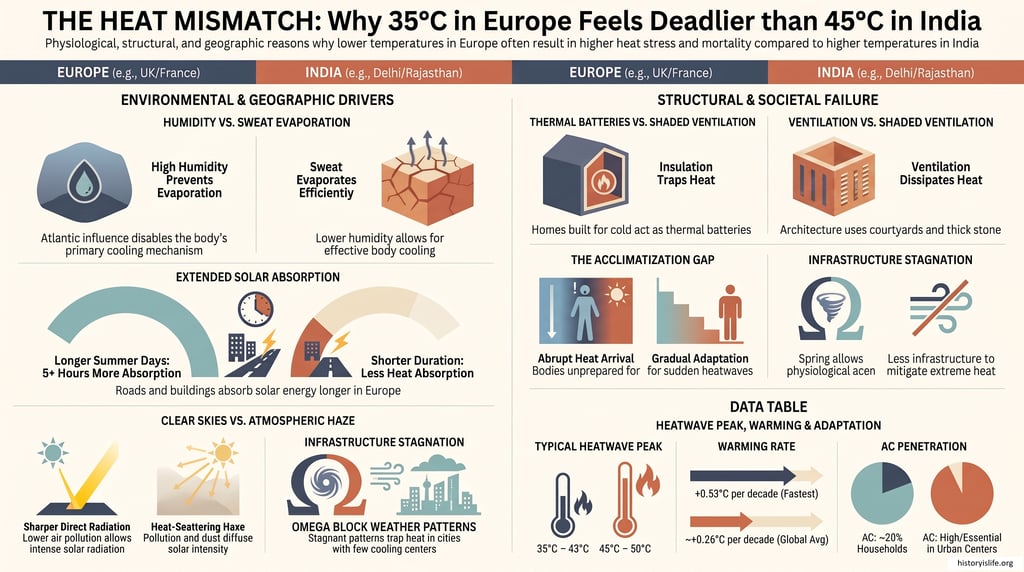
The primary reason 35°C in the UK is a physiological crisis while 45°C in Rajasthan is a dry inconvenience lies in the "sweat trap." The human body is essentially an evaporative cooler; we survive by shedding heat as moisture leaves our skin. In the moisture-heavy air of the Atlantic-moist UK, where humidity often hovers at 40% even on hot days, this mechanism stalls. Contrast this with the 20% humidity of Madrid or Northern India, where sweat evaporates almost instantly.
Meteorologists track this via "wet-bulb temperature"—a metric of heat-plus-humidity. According to the Centre for Science and Environment (CSE), while 35°C wet-bulb is the theoretical limit of human survival, the real danger begins much lower.
"The evaporation of sweat cools the body. But if the moisture in the air is too high, the rate of evaporation is slower or negligible... At such a point, the temperature of the body starts increasing, which could be lethal. Internationally, the safe limit of wet-bulb temperature for humans is below 30°C... Between 30°C and 35°C, the human body undergoes hyperthermia, leading to discomfort and impacts on organs." — Centre for Science and Environment
In London, a 35°C day with 45% humidity can push the wet-bulb temperature toward the 30°C threshold, forcing the cardiovascular system into a desperate, high-stakes race to keep core temperatures from climbing.
"Thermal Batteries": Why European Architecture is a Summer Liability
For centuries, European builders obsessed over a single enemy: the cold. They built homes with thick brick walls, heavy insulation, and double-glazed windows to trap every stray calorie of heat. In 2026, these features have turned the continent’s housing stock into "thermal batteries." These buildings soak up solar radiation during the 17-hour summer days and radiate it back into the living space at night, creating a "sweatbox" effect that prevents the body from recovering.
Unlike Indian cities, which evolved with "mutual shading"—where buildings are positioned to cast shadows on one another—European urban geometry often leaves streets and facades exposed to a day-long solar bombardment.
Built for the Wrong Climate
Roofing Materials: Paris's famous zinc roofs are thermal disasters; they absorb heat rapidly, turning upper-floor apartments into ovens. Indian architecture prioritizes high-albedo, reflective surfaces or shaded terraces.
Insulation & Walls: Thick European insulation acts as a one-way valve, keeping heat trapped inside during the "Tropical Nights." Indian design relies on stone flooring (conductors) and high ceilings to facilitate heat dissipation.
Urban Geometry: European cities often lack the narrow, shaded streetscapes and central courtyards found in older Indian urban centers, which use the "stack effect" for natural ventilation.
Impervious Surfaces: European cities are often "compact mid-rise" with massive amounts of concrete and asphalt. This creates a more intense Urban Heat Island effect than the shaded, ventilated layouts found in traditional tropical architecture.
The 17-Hour Sun and the Pollution Paradox
There is a geographical cruelty to the European summer. Because cities like London and Paris sit farther north than Toronto, they experience 15 to 17 hours of daylight. This allows infrastructure to absorb solar energy for nearly two-thirds of the day, leaving the few hours of darkness insufficient for the "nocturnal cool-down."
Adding to the intensity is the "Pollution Paradox." In Indian cities, a "hazy shield" of suspended particulate matter and aerosols often scatters sunlight, muting the intensity of direct radiation. Europe, following decades of successful air quality regulations, enjoys remarkably clear skies. Ironically, this lack of pollution allows solar radiation to reach the skin more directly. The sun feels "sharper" and more "burning" because there is no particulate veil to diffuse the energy. This direct solar radiation can cause skin to feel like it is scorching even when the air temperature is technically lower than in the sub-continent.
The "Garish" Appliance: The Political War Over AC
For decades, air conditioning was dismissed by Europeans as a "garish American luxury." In France, a cultural belief persisted that AC-chilled air caused illness, leading to a continent where only 20% of households own a unit. But as mortality climbed during the 2026 heatwave, the "anti-AC" culture wilted into what retailers described as "Black Friday buying vibes."
The appliance has now moved from a luxury to a political flashpoint. In France, the National Rally has proposed a €20bn "National AC Plan," framing cooling as a fundamental right for the elderly and the poor—those living in "thermal inequity" in zinc-roofed social housing. Meanwhile, the Left argues that AC is a "vicious cycle" that trades indoor comfort for outdoor catastrophe.
"Policymakers and climate experts have long argued that widespread air-conditioning creates a vicious cycle: it increases electricity demand, much of which is still met by fossil fuels, while also releasing waste heat outdoors and making cities even hotter." — The Indian Express
The Acclimatization Gap: The Absence of a "Slow Burn"
Physiologically, the human body can adapt to heat, but it requires a "slow burn." In India, the gradual transition through spring allows the body to increase cardiovascular efficiency and begin sweating at lower temperatures.
In contrast, European heatwaves are often "abrupt swings." When a population goes from a rainy 15°C May to a record-breaking 35°C June in a matter of days, the cardiovascular system is caught off guard. There is no time for the biological adjustments required to survive the heat, turning manageable weather into a mass-fatality event.
Conclusion: A Continent at a Crossroads
Europe is no longer the temperate sanctuary it once was. According to data from the Copernicus Climate Change Service, Europe is the fastest-warming continent on Earth, heating at a rate of 0.53°C per decade—exactly double the global average of 0.26°C.
The continent now stands at a crossroads. Its historic streetscapes, zinc roofs, and centuries-old building techniques are increasingly lethal in the face of an irreversible summer reality. To survive, Europe may have to sacrifice its architectural character and rethink its climate goals, acknowledging that in a 0.53°C-per-decade world, the "sweatbox" is no longer a home—it is a hazard. The question remains: can Europe adapt its infrastructure as quickly as the climate is adapting its thermometers?